




Every procedure at Hair Transplant Edinburgh is carried out by a doctor on the GMC register
Our Edinburgh clinic is in the heart of the city, easy to reach by tram, bus, or train
An honest assessment of your donor supply and realistic outcome, no sales pressure, no obligation to proceed
We limit patient numbers so your surgeon gives your case the full attention it deserves
Hair transplant surgery plays a meaningful role in gender-affirming care for many transgender and non-binary individuals. Modifying the hairline, increasing or decreasing density in specific zones, or restoring hair lost to hormone changes or prior hair loss are all achievable with surgical transplantation. The approach is individual, and the goals differ significantly from person to person.
At Hair Transplant Edinburgh, we treat transgender patients with the same approach as any other patient: a thorough consultation to understand your goals, an honest assessment of what is achievable, and a surgical plan built around your specific presentation. Dr Aziz Elgindi, Dr Mohammed Ditta, and Dr Tetiana Mamontova have experience in hairline redesign and hair restoration for patients at different stages of gender transition.
Transgender Hair Transplant in Edinburgh
Hair plays a significant role in how gender is read and expressed. For many transgender women (MTF), a masculine hairline pattern, whether acquired through androgenetic alopecia or simply reflecting a naturally higher male hairline position, can undermine the effect of other feminising changes and affect confidence and wellbeing. For transgender men (FTM), the absence of a defined male hairline or the presence of very feminine hairline characteristics can similarly create a disconnect between how they see themselves and how others perceive them.
Surgical hair restoration can address both directions: feminising a hairline for MTF patients, and masculinising one for FTM patients. In both cases, the underlying technique is FUE (follicular unit extraction), and the design process is the most important part of the procedure.
Edinburgh, as a city with a longstanding commitment to equality and a well-developed healthcare infrastructure, is a sensible place to access specialist hair restoration treatment within a supportive clinical environment. Our clinic at 93 George Street is easy to reach from across Scotland.
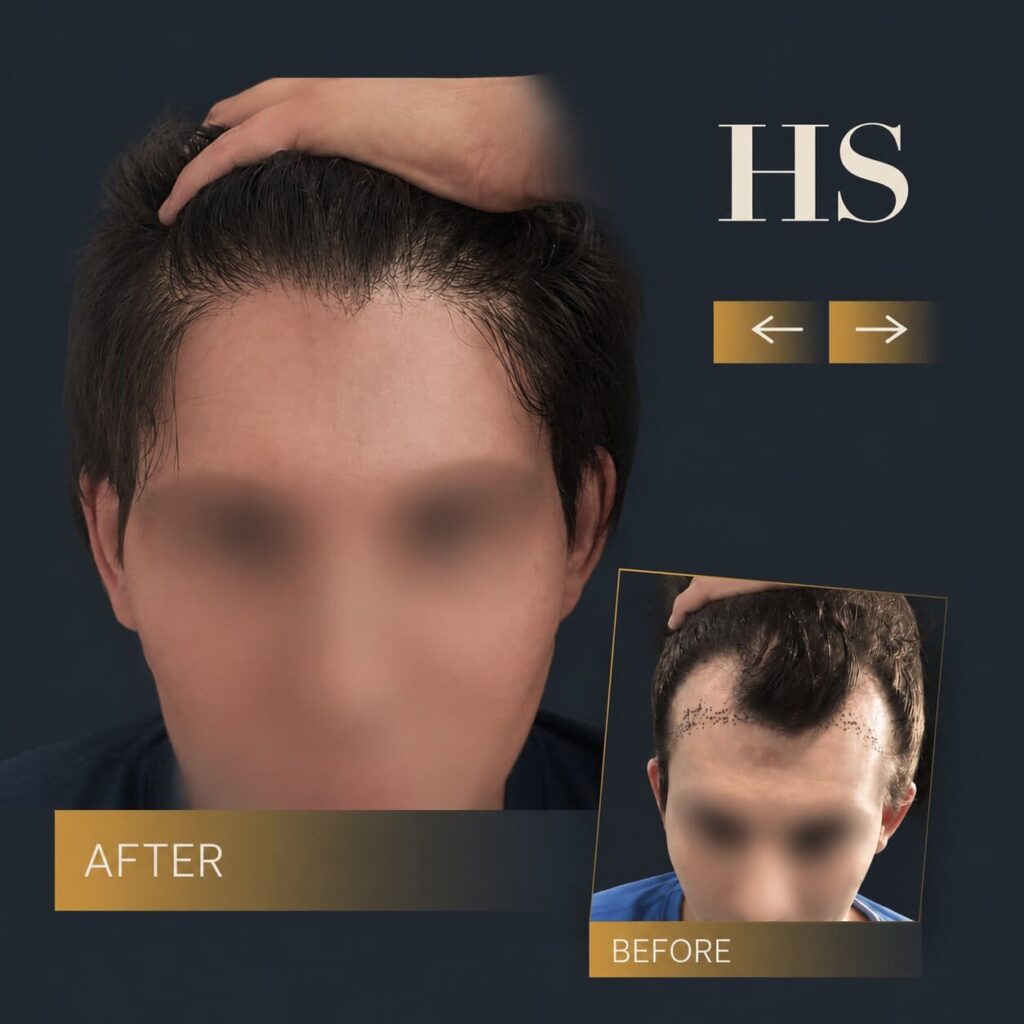
Before and After Transgender Hair Transplant Results in Edinburgh
A selection of results from patients treated at our Edinburgh clinic. Every procedure shown was performed by our GMC-registered surgeons. View the full gallery.
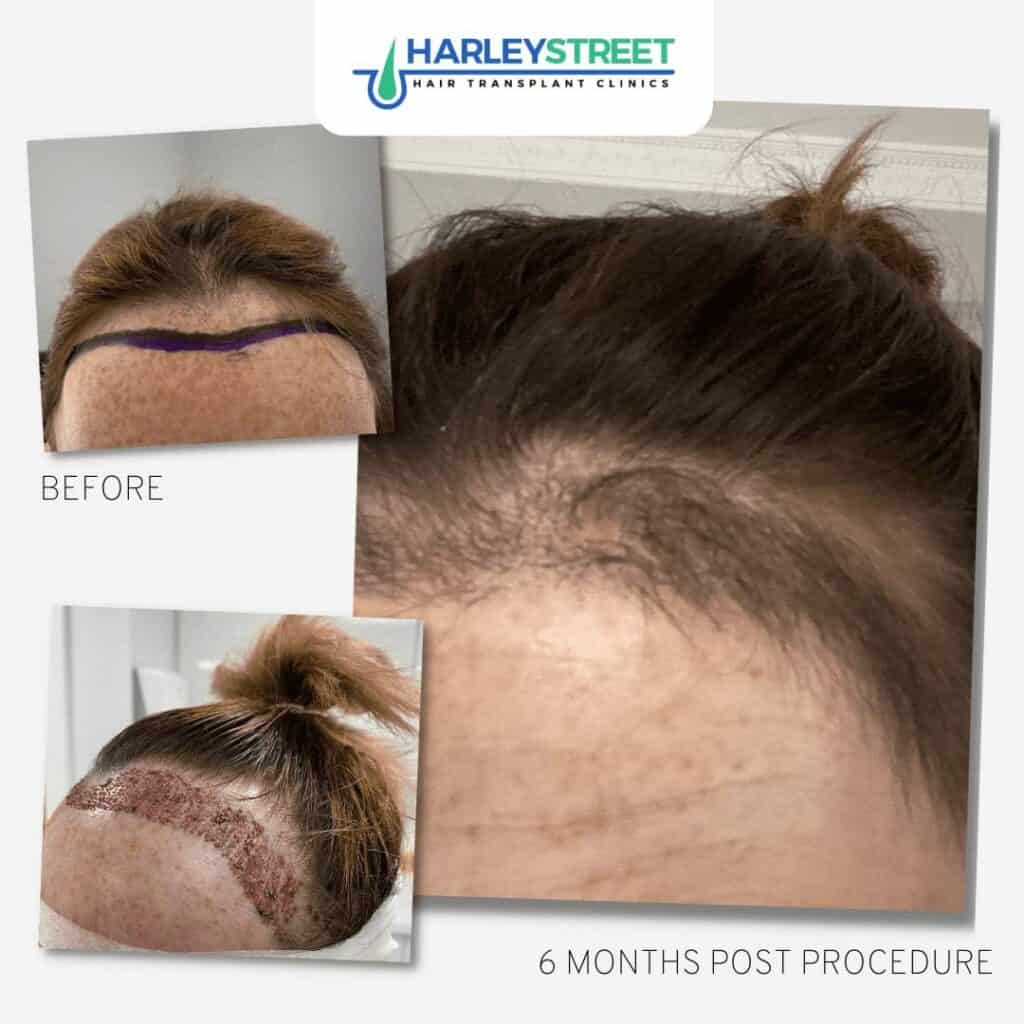
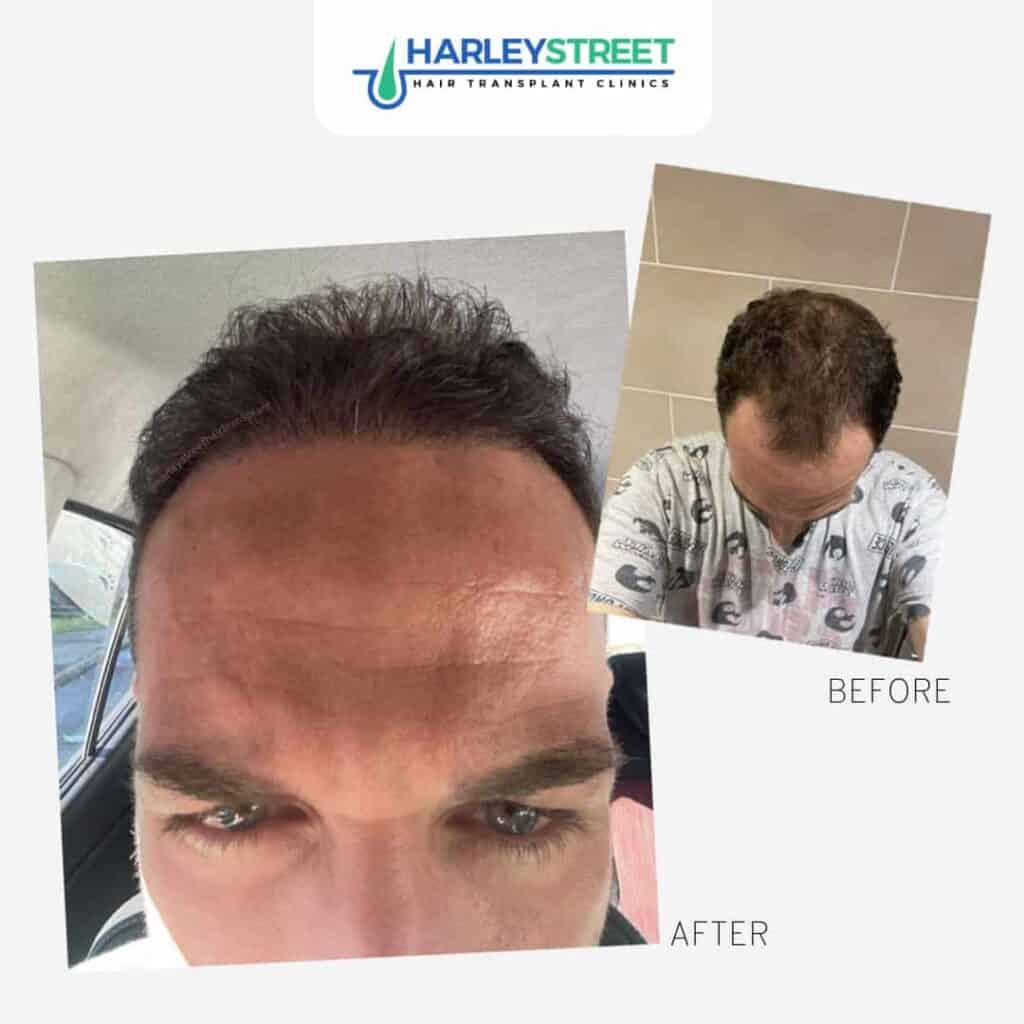
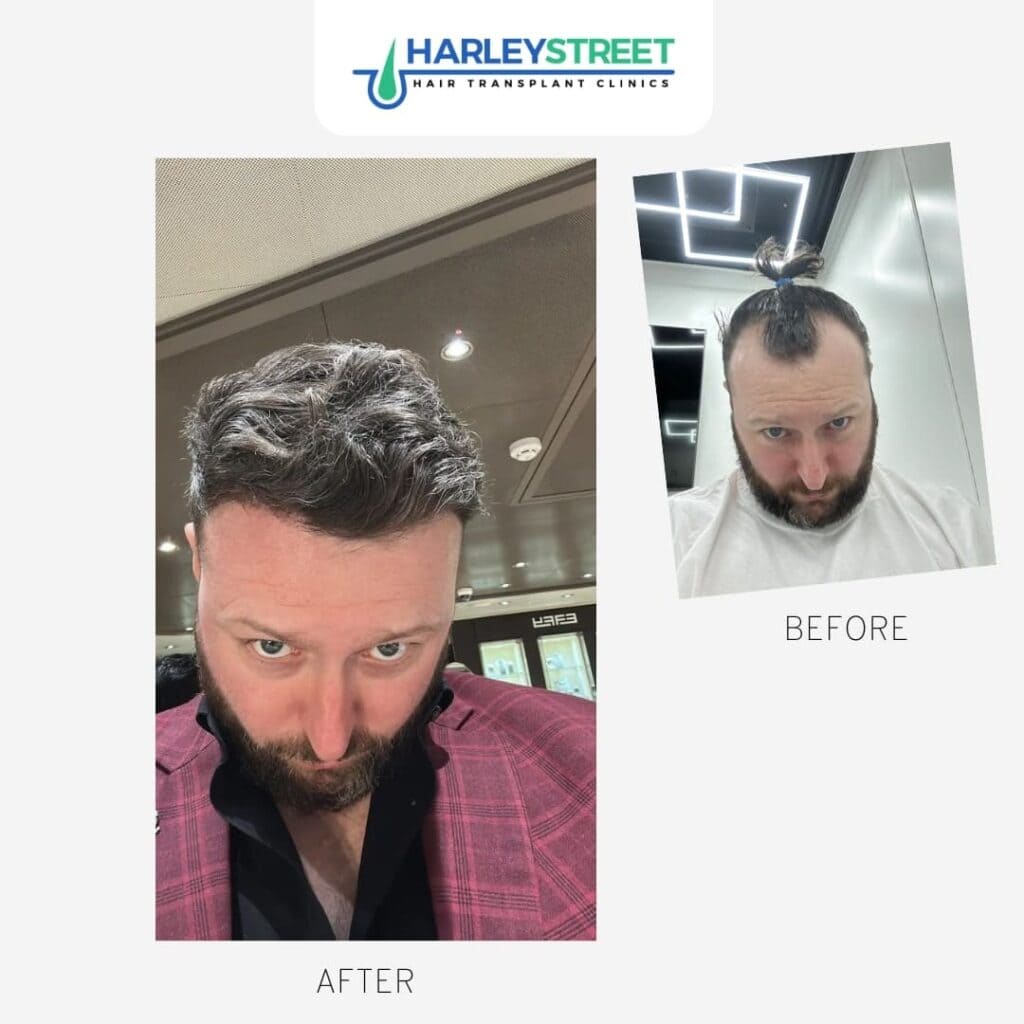
MTF Hairline Feminisation
A male hairline typically sits higher on the forehead than a female one, particularly at the temples, where recession creates the characteristic M-shape of the Hamilton-Norwood pattern. Even in men who have not experienced significant baldness, the natural position and curve of a male hairline differs from a female one in ways that affect perceived gender.
A feminising hairline transplant lowers the central hairline position, reconstructs the temporal regions to remove the M-shape recession, and creates a rounded or softly curved front edge with fine single-hair grafts at the border. This is called hairline feminisation or a feminising frontal hairline transplant.
Key differences between a feminine and masculine hairline that inform the design:
- A feminine hairline typically sits 5 to 6 centimetres above the brow, compared to 6 to 8 centimetres in a male-pattern position
- The temporal recession characteristic of the male hairline is filled in, creating a more oval or elliptical hairline shape
- The transition from forehead to hairline is softer and more gradual, using fine single-hair grafts at the very front edge
- The corners may have a gentle widow’s peak or slight central dip depending on the patient’s facial shape
For MTF patients who have also experienced androgenetic alopecia prior to or during transition, the hairline transplant may address both feminisation and hair restoration simultaneously. Patients on long-term oestrogen therapy who have experienced some reversal of male pattern thinning will have that assessed at consultation to understand what remains for surgical restoration.
If there is also thinning at the crown or across the mid-scalp, our crown hair transplant Edinburgh covers vertex restoration as a separate or combined procedure.
FTM Hairline Masculinisation
For transgender men, the goal is typically the reverse: creating a hairline that presents as masculine. This usually means adjusting the position, creating temporal recession that reflects natural male hairline characteristics, or modifying a hairline that sits too low and too rounded to appear convincingly male.
FTM patients on testosterone therapy may also experience the onset of androgenetic alopecia as androgens affect the scalp. This can create hair loss that follows a male pattern and may eventually require management in the same way as hair loss in any other patient with androgenetic alopecia.
Masculinising hairline work typically involves fewer grafts than feminising work, as the goal is often to recreate specific recession characteristics rather than to lower and fill in the hairline. The surgeon will assess your current hairline and discuss exactly what design is appropriate for your facial structure and transition goals.
Our FUE hair transplant Edinburgh covers how grafts are harvested and placed in full technical detail. Our DHI hair transplant Edinburgh explains an alternative placement technique that may also be suitable.
Timing and Hormone Therapy
For MTF patients, a period of stability on hormone therapy is generally recommended before a hairline feminisation procedure. Oestrogen therapy can reduce the progression of androgenetic alopecia and, in some patients, leads to partial regrowth. Operating before this stabilisation is complete risks transplanting into a scalp that is still changing, which can affect the outcome.
The standard recommendation is 12 to 24 months on oestrogen therapy before assessing the scalp for hairline feminisation, though this is patient-specific and depends on the degree of prior hair loss and the expected effect of hormones on the individual pattern.
For FTM patients on testosterone, the opposite consideration applies. Testosterone therapy can initiate androgenetic alopecia in genetically predisposed individuals. If masculinising hairline work is planned while testosterone-driven thinning may be ongoing, the surgeon will discuss how to account for future loss in the hairline design.
If you have questions about whether your current hormone therapy affects your candidacy for hair transplant surgery, this is covered in detail at your free consultation. All relevant medical history is reviewed before any surgical plan is prepared.
How Many Grafts for a Transgender Hair Transplant?
Graft requirements vary based on the goals and the starting hairline position.
- MTF hairline feminisation (hairline lowering and temple fill): typically 1,500 to 2,500 grafts, depending on the degree of recession and the target hairline position
- MTF full restoration (hairline plus mid-scalp after androgenetic alopecia): 2,500 to 4,000 grafts, often staged across more than one session
- FTM masculinising adjustments: usually 500 to 1,500 grafts, depending on the nature and extent of modification needed
All pricing is discussed at your free consultation. Our hair transplant cost Edinburgh provides an overview of how graft-based pricing works. Finance options are available for patients who prefer to spread the cost.
For patients also considering eyebrow restoration, our eyebrow transplant Edinburgh covers how brow restoration can be part of a broader facial feminisation hair plan.
Make the best investment in yourself and find out more about how we can help eliminate hair loss for good!
Where to Find Us
Hair Transplant Edinburgh is centrally located and easily accessible from across the Lothians and beyond. Find us at our Edinburgh clinic:
Hair Transplant Edinburgh
93 George Street
Edinburgh
EH2 3ES
Our Edinburgh clinic is well connected by public transport:
- Tram: West End Princes Street stop (5 minute walk)
- Train: Edinburgh Waverley and Haymarket stations (both within 15 minutes on foot)
- Bus: Multiple Lothian Buses routes along Princes Street and Queensferry Street
If you are travelling by car, the clinic is a short drive from the city centre with several pay and display car parks nearby in the West End area.
FAQs
Yes. Transgender patients are assessed using the same principles as any patient: stable hair loss, adequate donor density, clear goals, and realistic expectations about outcomes and timelines. The design principles differ based on the patient’s transition goals, whether that is hairline feminisation for MTF patients or masculinising adjustment for FTM patients, but the technique is the same FUE procedure used for all hair restoration at our clinic.
The general recommendation is 12 to 24 months of oestrogen therapy before considering a hairline feminisation procedure. This allows the scalp to stabilise: oestrogen can reduce or halt androgenetic alopecia and in some patients produces partial regrowth, which affects both the candidacy assessment and the graft count needed. This is a guideline rather than a fixed rule, and your specific situation will be discussed at consultation.
It can, in genetically predisposed individuals. Testosterone therapy raises androgen levels, and if you carry the genetic variant associated with androgenetic alopecia, this can trigger or accelerate male-pattern thinning. Not all transgender men on testosterone develop hair loss. Whether this is a factor for you, and how to manage it medically or surgically, is discussed at consultation.
Yes, when designed and executed correctly. Feminising hairlines use fine single-hair grafts at the very front edge to create a soft, gradual transition. The surgeon adapts the design to suit your facial proportions and the specific feminine hairline shape that frames your face best. The result at 12 months, once growth is complete, is indistinguishable from a naturally occurring hairline.
Yes. All consultations at Hair Transplant Edinburgh are private and confidential. Your medical history is treated with the same discretion as any other patient’s. You are welcome to bring a friend or partner to the consultation if that would make you more comfortable. The consultation is a clinical conversation about your hair and your goals, conducted in a supportive environment.
Yes, in some cases. Whether a combined same-day procedure is appropriate depends on the total graft count required across both areas. A feminising hairline transplant of 2,000 grafts and an eyebrow restoration of 300 to 400 grafts per side could be planned for the same session, depending on the duration and your donor supply. Your surgeon will confirm what is feasible at consultation. Staged procedures are also an option if the combined count or session length makes a same-day approach impractical.
Patient Testimonials
Aside from achieving fantastic results, we believe that keeping in touch with our patients before, during and after their hair transplantation procedure is paramount – it helps to keep our patients feeling calm and in control. We’re always on hand to provide guidance, support and aftercare advice. Time and again, our patients tell us that this is what sets us apart from other clinics.
You can read our great reviews of FUE hair transplants over on Google and Trustpilot